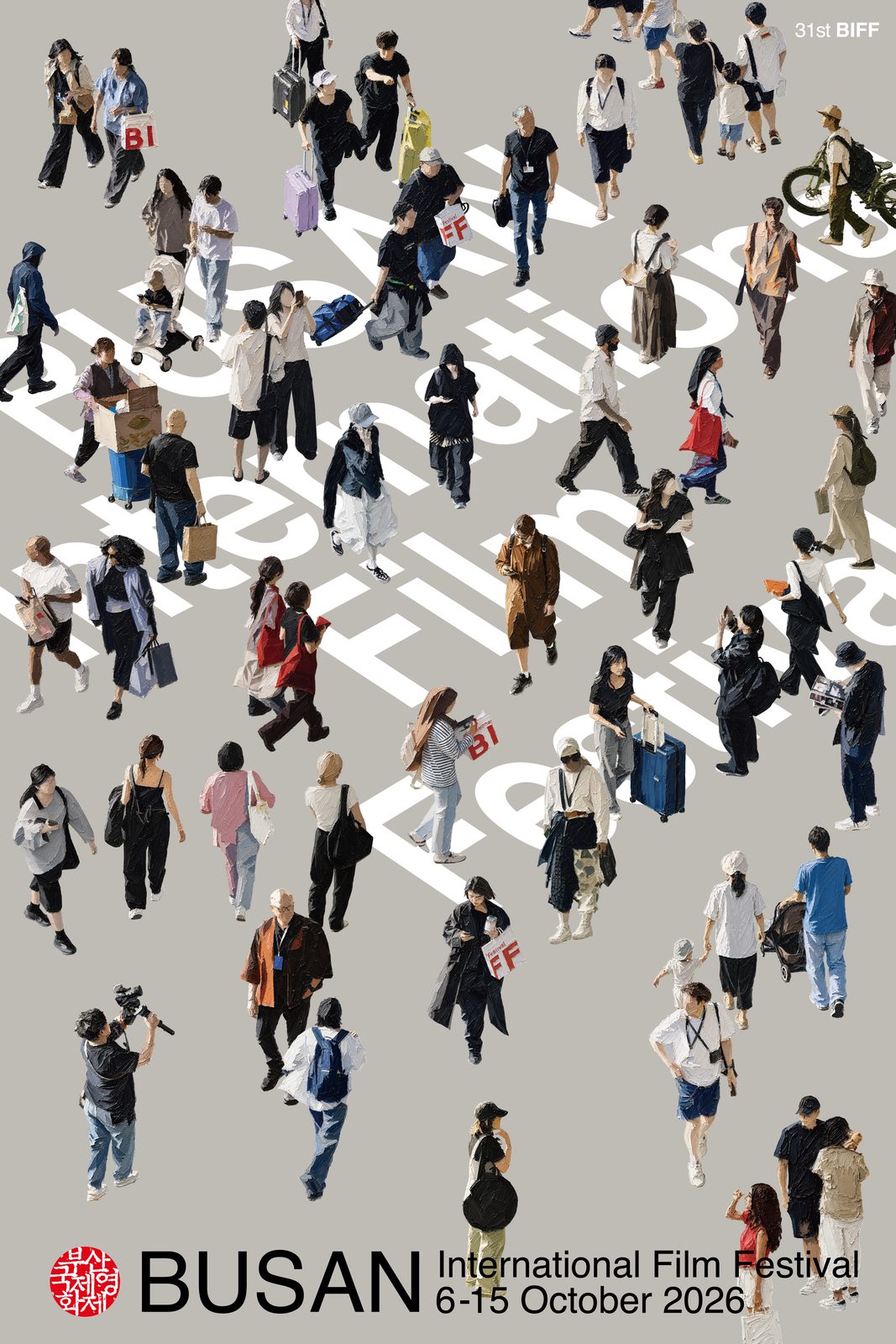
31st BUSAN International Film Festival
DATES ㅣ Oct 6 (Tue) – 15 (Thu), 2026
Screening Venues
31 Screens in 8 Theaters
Busan Cinema Center, CGV Centum City, LOTTE CINEMA Centum City, KOFIC Theater, Sohyang Theatre Woori Bank Hall, Busan Community Media Center Open Hall
※ Community BIFF: MEGABOX Busan Theater, Catholic Center Space 101.1
Screenings
316 films in total
∙ Official Selections: 247 Films from 59 Countries (World + International Premiere: 105 Films / World Premiere: 95 Films / International Premiere: 10 Films
∙ Community BIFF: 69 Films
Features Overview
01 Growing Global Presence, A Leading Hub for the Global Film Community
The 31st Busan International Film Festival (BIFF) has taken another major step forward with its growing international stature. This year, BIFF was officially recognized by the International Federation of Film Producers Associations (FIAPF) as an “A-list festival,” joining the ranks of major international film festivals including Cannes, Berlin, and Venice. Building on this recognition, the winner of the Busan Award for Best Film, the top prize in BIFF’s Competition, now qualifies for submission to the Academy Award for International Feature Film. BIFF is now one of only six qualifying festivals designated by the Academy of Motion Picture Arts and Sciences (AMPAS), alongside Cannes, Berlin, Venice, Sundance, and Toronto.
Reaffirming its commitment to global solidarity within the film community, this coming September, the Festival will participate in the first ‘Lumière Summit,’ co-hosted by South Korea and France, joining film and audiovisual industry leaders from around the world in discussions on the future of cinema. Having spent the past three decades discovering Asian cinema and connecting it with the world, BIFF is now expanding its role beyond that of an internationally recognized film festival to become a global platform helping shape the future of cinema..
02 Expanded Screenings Opportunities & Greater Convenience for Festivalgoers
The 31st BIFF presents a total of 246 official selections—an increase of 6 titles from the previous edition, marking the festival’s largest lineup since 2019. The festival will also open one day earlier than in previous years, on Tuesday, October 6, giving audiences greater flexibility in planning their visits and screenings during the busy first week. During the festival’s busiest period from Thursday through Sunday, daily screenings will expand from the usual four slots to five, creating more opportunities for audiences to catch the festival’s most talked-about titles. With its first-ever Tuesday opening and expanded screening schedule, BIFF aims to offer audiences greater flexibility and a wider range of films to enjoy..
03 Competition Gains Momentum with a Formidable Lineup
Competition section, launched in 2025, enters its second year. Building on the strong interest and achievements of its inaugural edition, the overall quality and depth of submissions have risen significantly this year, with 13 films ultimately selected. Together, they represent some of the most compelling works in contemporary Asian cinema. The lineup includes Beach Fictions by promising newcomer Lim Hayeon and Between Two Lovers, a nuanced love-triangle drama by Hirose Nanako, an acclaimed filmmaker whose work spans both fiction and documentary. The Day After Sunday, a collaboration between Kato Takuya, a director leading a new wave, and acclaimed Japanese actress Kuroki Haru. Internationally recognized filmmaker Gu You teams up with acclaimed Chinese actor Zhou Xun for the beautifully rendered family drama The First Taste of Loneliness, and emerging filmmaker Botir Abdurakhmanov presents the powerful Hilol. Youm Kyubock’s moving animated feature Long Long Night is adapted from the acclaimed children’s book of the same title. Also in the lineup is Midday Meal, the latest film by acclaimed Iranian filmmaker Majid Majidi, poised to become one of his signature works of the 21st century, alongside IBUKU by accomplished Indonesian filmmaker Eddie Cahyono. Established Japanese filmmaker Okita Shuichi brings the charming and delightful Satoko Always, while Yosep Anggi Noen’s The Sea Speaks His Name showcases the scale and vitality of Indonesian cinema. Kim Jung-hoon’sShaving demonstrates the strength of Korean genre cinema, and Tanaka Miki’s silver express draws attention with its bold subject matter and distinctive visual style. Rounding out the selection is To Be Ordinary by veteran Taiwanese filmmaker Lee Yun Chan, a powerful portrayal of the cruelty and hope of life.
04 A Sharper Vision of Asian Cinema’s Present and Future
Entering its second year since being restructured last year, the Vision section offers a broader look at the current landscape and new possibilities of Asian independent cinema. Vision – Korea brings together emerging talents and established filmmakers, striking a dynamic balance across generations. The lineup includes the animated feature debuts of Kim Si-jin and Kim Hyomi; directors such as Shin Dongmin, Park Kun-young, and Jeong Jihye, who are presenting their films at BIFF for the first time; and Sohn Hyun-lok, Shin Sun and Oh Sehyeon, who return to Busan with new films following their previous appearances at the festival. Meanwhile, the lineup also highlights works by established directors such as Kim Miyoung, Park Hong-min, Park Songyeol, and Jang Woojin, who have steadily developed distinctive cinematic worlds of their own.
Vision - Asia likewise brings together both new faces and familiar names. The selected films span a broad range of Asian countries and regions, from China, Hong Kong and Japan to the Philippines, Vietnam, Thailand, India, Mongolia, Kazakhstan, and Iran, reflecting an increasingly diverse cinematic landscape. Notably, Mongolian director Sakhya Byamba, who won the New Currents Award at BIFF in 2013 for Remote Control, returns to Busan with a new film, while established filmmakers such as Vietnam’s Nguyễn Hoàng điệp will also present their latest works. The lineup also introduces filmmakers who have worked across short filmmaking, cinematography, acting, advertising, music videos and other fields before moving into feature filmmaking, offering audiences the chance to discover new voices to watch in Asian cinema.
Bringing together filmmakers from different generations and at different stages of their careers across Korea and Asia, the Vision section goes beyond discovering emerging directors to offer one of the most vivid windows onto the diverse currents and possibilities of Asian independent cinema today.