


The Dissidents 2026
异见者
Sep 4 – 13, 2026, China
EndedWebsite
About
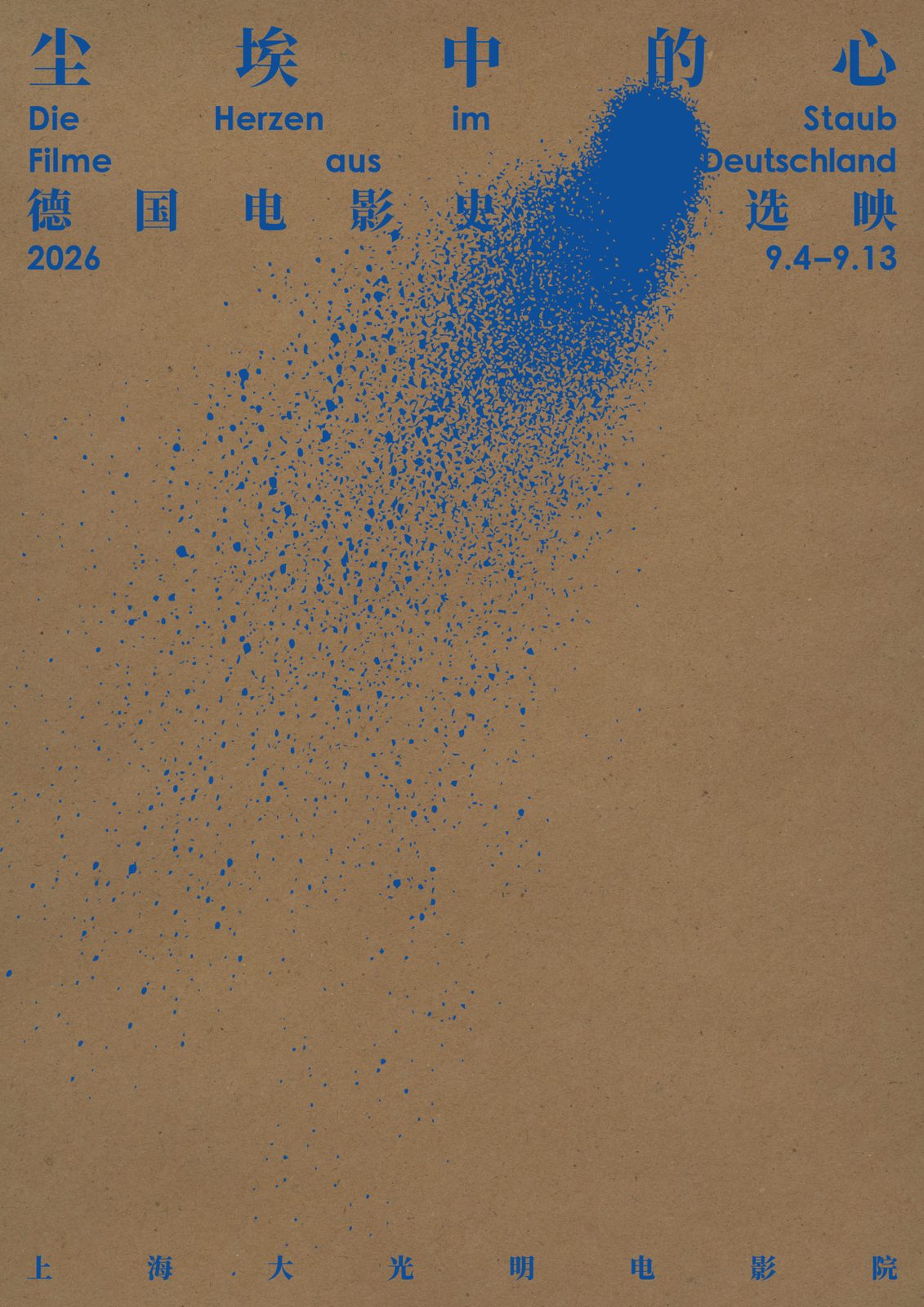
Presented by Shanghai Grand Cinema, and co-presented by TheDissidents and Reaching Project, Hearts in the Dust: Films from Germany takes place from September 4–6 and September 11–13, 2026, at the LUXE Hall of Grand Cinema (216 Nanjing West Road, Shanghai). Tickets have gone on sale at 12:00 noon on Wednesday, September 2. All screenings are priced at RMB 75, excluding online service fees. Tickets will be available through Taopiaopiao and Maoyan.
The program brings together classic works by nine filmmakers, including Fritz Lang, Jean-Luc Godard, Helma Sanders-Brahms, Helke Sander, Maren Ade, Danièle Huillet and Jean-Marie Straub, Peter Nestler, and Harun Farocki. Spanning eight features and one short film, the selection traces a long historical arc extending from antiquity to the present day.
All films are provided with English and Chinese subtitles with the exception of The All-Around Reduced Personality and Antigone, which are planned to be screened from 35mm film prints with Chinese-only closed captions.
To further expand on the program, we have also invited the renowned scholar and poet Hu Sang to give a special lecture, “The Gesture of Antigone.” The lecture will be held from 7:00 to 9:00 p.m. on Thursday, September 10, at Baixin Bookstore on East Nanjing Road. Further details will be announced in a forthcoming post.
Curatorial Statement: When Our Hands Lift the Heart from the Dust (Space Rabbit)
“We walk, our hearts in the dust.” So wrote the 22-year-old Ingeborg Bachmann in 1948.
We cannot tell whether this heart has already been left somewhere by the one who walks, or whether it is still beating in her chest. Perhaps both are true — walking marks out the distance between a person and the ruins, yet at the same time one can never truly move away from that dust-covered heart. We can point to where this dust comes from: without doubt, from the places where the history of Germany, of Europe and of the whole world broke apart. And yet the dust still feels strange to us: dust comes from ruins but is not the same as ruins; however the destroyed world may be rebuilt, dust has always already cruelly invaded every body. Dust has become part of our breathing. Dust shapes our understanding of light. Dust seeps into every smallest crevice, and yet it does not come from any definite place or time. One can keep writing in the form of a chronicle, can search an endless succession of dates and moments for omens, but often has to admit one’s own failure. Dust is failure — the failure of language, the failure of myth — the failure of love; and at the same time it is the triumph of terror: whatever made the ruins into ruins prolongs its life through dust.
The name “Hotel Luxor” in The Thousand Eyes of Dr. Mabuse [Die 1000 Augen des Dr. Mabuse, 1960] embodies precisely this idea. A name derived from the Latin word for “light” [lux] becomes, in this film, a byword for darkness. Built in the Nazi era, the hotel is taken over after the war by the sinister “Dr. Mabuse” and becomes the place where conspiracies of surveillance and control are carried out. “Light” thus turns into an evil gaze that penetrates everything, wanting to make everything transparent and draw it into its field of vision. Fritz Lang’s Dr. Mabuse films are always films about some kind of “after”: after the First World War, after the Nazis came to power, after the Nazi regime fell… Having fled Germany, Lang met in Hollywood another totalitarianism called the studio system, which gave him an exceptionally lucid understanding of the power relations contained in images and in vision. Whereas the first two Dr. Mabuse films set the audience face to face with Dr. Mabuse, seeing through the truth even as they are hypnotised, The Thousand Eyes of Dr. Mabuse concentrates far more on showing the hand that manipulates the images. Whether Dr. Mabuse’s hand is picking up a telephone, working a remote control or coldly editing surveillance footage, it stands for the sending of commands and the desire for control; this bodiless hand becomes the embodiment of power and of the mechanisms by which it works: Dr. Mabuse lives forever.
The depiction of the “hand” runs through our history. Perhaps we have already seen this hand somewhere else. In his poem “Germany”, Brecht wrote: “Your poorest son / Has been struck down / When he was hungry / Your other sons raised their hands against him.” In Germany in 1933, that raised hand became a symbol of honour, but it also became Germany’s shame. In the poem Brecht calls Germany a “pale mother”, and Helma Sanders-Brahms took this as her title and quotes the entire poem at the very beginning of her film. In Germany Pale Mother [Deutschland bleiche Mutter, 1980], Sanders-Brahms uses an autobiographical form to tell the story of an ever-ageing father and an unhappy mother. In the narration of the film’s “I”, the word “father” has irretrievably merged with “fatherland”, and the mother can no longer be kept apart from the pale mother of Brecht’s poem. The history of men has been written — but what about the history of women? There are no pure memories any more, because there are no pure words any more. Dust covers everything. The task Sanders-Brahms set herself was precisely to find, beneath this contamination, a hidden path that belongs to mothers and daughters, even if that means pain.
But after all, there are still the hands that labour: hands that exist not to send or receive orders, but to bury the dead or embrace the living, and to think about their own history.
First there is Godard, who “thinks with his hands”. Cinema is necessarily the labour of hands, and the image of a hand also contains the history of labour. In Germany Year 90 Nine Zero [Allemagne année 90 neuf zéro, 1991], Godard repeatedly questions the classic figures that shaped the myths of Europe. After Alphaville in the 1960s, Godard once again calls on Lemmy Caution, the classic tough guy of French film noir; but this time he has become no more than his own ghost: for a detective like him can no longer find a place for himself in the Germany of 1990, just like the historical figures he encounters. What Godard asks is this: when these figures take on flesh, when these myths no longer occupy their self-evident place in our thinking, what will the Germany of 1990 look like?
Similarly, in Antigone by Sophocles [Die Antigone des Sophokles, 1992] and Eyes Do Not Want to Close at All Times [Les yeux ne veulent pas en tout temps se fermer, ou Peut-être qu’un jour Rome se permettra de choisir à son tour, 1970], Huillet–Straub do not concentrate on narrative storytelling, and they reject a logic of representation. They know this fact all too well: the past cannot be represented and cannot be recovered. They therefore insist that the texts of Brecht/Hölderlin and of Corneille be spoken according to a strict method, insist on the solidity of the text as reality, question the places where history broke and was misunderstood, and rescue the German language from that terrible thinking of command. Hölderlin wanted Antigone to struggle between gods and men; Brecht turned the story of Antigone into an allegory of Germany’s fate. Huillet–Straub place all of this back into history, back into human bodies; they resolutely take the actors’ gestures and the modernised landscape into the frame together. In their films the law of the gods is no longer possible, and the dead demand justice from within the enclosure of the landscape. Every gesture of the actors, as well as their speaking and their pauses, carries its entire history.
Section
Venue
Baixin Bookstore (East Nanjing Road)Shanghai Grand Cinema LUXE Hall 1